Infertility conditions which need Surgical Corrections
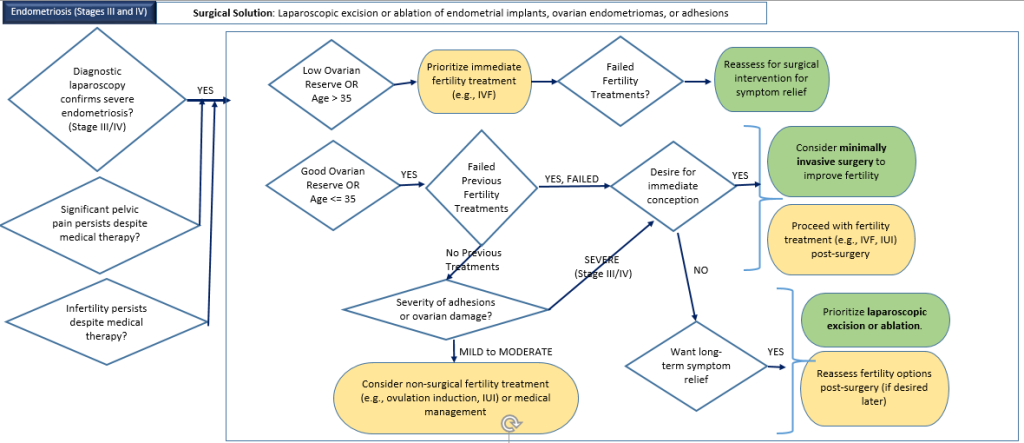
1) Endometriosis (Stages III & IV) 
Description: A condition where tissue similar to the uterine lining grows outside the uterus, causing scarring and adhesions.
Symptoms: Severe pelvic pain, painful periods, pain during intercourse, infertility.
Diagnostic Methods: Diagnostic laparoscopy, transvaginal ultrasound, MRI.
Surgical Options Available: Laparoscopic excision or ablation of endometrial implants, adhesions, and ovarian endometriomas.
Alternative Treatments: Hormonal therapies (e.g., GnRH agonists), pain management, lifestyle changes.
Symptoms: Severe pelvic pain, painful periods, pain during intercourse, infertility.
Diagnostic Methods: Diagnostic laparoscopy, transvaginal ultrasound, MRI.
Surgical Options Available: Laparoscopic excision or ablation of endometrial implants, adhesions, and ovarian endometriomas.
Alternative Treatments: Hormonal therapies (e.g., GnRH agonists), pain management, lifestyle changes.
Potential Adversities of Delaying Surgery
Delaying surgery for endometriosis (Stages III and IV) can lead to:
1) Progressive scarring and adhesions, reducing the chances of natural conception and making future surgical correction more difficult.
2) Chronic pelvic pain, which may become resistant to medical treatment and negatively impact quality of life.
3) Reduced ovarian reserve, especially in women with existing low ovarian reserve or advanced maternal age, lowering the chances of successful fertility treatments.
4) Increased risk of organ involvement, such as bowel or bladder adhesions, leading to more complex surgical procedures and potential long-term complications.
5) Emotional and financial burden, due to repeated failed fertility treatments without addressing the underlying cause.
Delaying surgery for endometriosis (Stages III and IV) can lead to:
1) Progressive scarring and adhesions, reducing the chances of natural conception and making future surgical correction more difficult.
2) Chronic pelvic pain, which may become resistant to medical treatment and negatively impact quality of life.
3) Reduced ovarian reserve, especially in women with existing low ovarian reserve or advanced maternal age, lowering the chances of successful fertility treatments.
4) Increased risk of organ involvement, such as bowel or bladder adhesions, leading to more complex surgical procedures and potential long-term complications.
5) Emotional and financial burden, due to repeated failed fertility treatments without addressing the underlying cause.
2. Uterine Fibroids (Myomas)
Description: A condition where tissue similar to the uterine lining grows outside the uterus, causing scarring and adhesions.
Symptoms: Severe pelvic pain, painful periods, pain during intercourse, infertility.
Diagnostic Methods: Diagnostic laparoscopy, transvaginal ultrasound, MRI.
Surgical Options Available: Laparoscopic excision or ablation of endometrial implants, adhesions, and ovarian endometriomas.
Alternative Treatments: Hormonal therapies (e.g., GnRH agonists), pain management, lifestyle changes.
Symptoms: Severe pelvic pain, painful periods, pain during intercourse, infertility.
Diagnostic Methods: Diagnostic laparoscopy, transvaginal ultrasound, MRI.
Surgical Options Available: Laparoscopic excision or ablation of endometrial implants, adhesions, and ovarian endometriomas.
Alternative Treatments: Hormonal therapies (e.g., GnRH agonists), pain management, lifestyle changes.
Potential Adversities of Delaying Surgery
Delaying surgery for endometriosis (Stages III and IV) can lead to:
1) Progressive scarring and adhesions, reducing the chances of natural conception and making future surgical correction more difficult.
2) Chronic pelvic pain, which may become resistant to medical treatment and negatively impact quality of life.
3) Reduced ovarian reserve, especially in women with existing low ovarian reserve or advanced maternal age, lowering the chances of successful fertility treatments.
4) Increased risk of organ involvement, such as bowel or bladder adhesions, leading to more complex surgical procedures and potential long-term complications.
5) Emotional and financial burden, due to repeated failed fertility treatments without addressing the underlying cause.
Delaying surgery for endometriosis (Stages III and IV) can lead to:
1) Progressive scarring and adhesions, reducing the chances of natural conception and making future surgical correction more difficult.
2) Chronic pelvic pain, which may become resistant to medical treatment and negatively impact quality of life.
3) Reduced ovarian reserve, especially in women with existing low ovarian reserve or advanced maternal age, lowering the chances of successful fertility treatments.
4) Increased risk of organ involvement, such as bowel or bladder adhesions, leading to more complex surgical procedures and potential long-term complications.
5) Emotional and financial burden, due to repeated failed fertility treatments without addressing the underlying cause.
3. Blocked Fallopian Tubes
Description: : Blockage in one or both fallopian tubes preventing fertilization.
Symptoms: Infertility, pelvic pain, irregular menstrual cycles.
Diagnostic Methods: Hysterosalpingography (HSG), laparoscopy.
Surgical Options Available: : Salpingostomy, tubal reanastomosis, or tubal cannulation.
Alternative Treatments: IVF.
Symptoms: Infertility, pelvic pain, irregular menstrual cycles.
Diagnostic Methods: Hysterosalpingography (HSG), laparoscopy.
Surgical Options Available: : Salpingostomy, tubal reanastomosis, or tubal cannulation.
Alternative Treatments: IVF.
Potential Adversities of Delaying Surgery
Delaying surgery for tubal factor infertility can lead to:
1) Progressive tubal damage, reducing the chances of successful repair.
2) Formation of hydrosalpinx, which negatively impacts natural conception and IVF outcomes.
3) Increased risk of ectopic pregnancy, especially if a partially blocked tube remains untreated.
4) Permanent infertility, particularly if both tubes are severely damaged or require removal.
5) Emotional and financial burden, due to repeated failed fertility treatments without addressing the underlying cause.
Delaying surgery for tubal factor infertility can lead to:
1) Progressive tubal damage, reducing the chances of successful repair.
2) Formation of hydrosalpinx, which negatively impacts natural conception and IVF outcomes.
3) Increased risk of ectopic pregnancy, especially if a partially blocked tube remains untreated.
4) Permanent infertility, particularly if both tubes are severely damaged or require removal.
5) Emotional and financial burden, due to repeated failed fertility treatments without addressing the underlying cause.
4. Polycystic Ovary Syndrome (PCOS) with Ovarian Drilling
Description: A hormonal disorder causing enlarged ovaries with cysts.
Symptoms: Irregular periods, infertility, weight gain, acne, hirsutism.
Diagnostic Methods: Ultrasound, hormonal tests.
Surgical Options Available: Laparoscopic ovarian drilling.
Alternative Treatments: Lifestyle changes, ovulation induction (clomiphene or letrozole), metformin.
Symptoms: Irregular periods, infertility, weight gain, acne, hirsutism.
Diagnostic Methods: Ultrasound, hormonal tests.
Surgical Options Available: Laparoscopic ovarian drilling.
Alternative Treatments: Lifestyle changes, ovulation induction (clomiphene or letrozole), metformin.
Potential Adversities of Delaying Surgery
Delaying ovarian drilling or further treatment for PCOS can lead to:
1) Prolonged anovulation, resulting in delayed conception and increased risk of endometrial hyperplasia or cancer.
2) Worsening hormonal imbalance, leading to persistent symptoms of hyperandrogenism (hirsutism, acne, alopecia).
3) Increased metabolic risks, such as insulin resistance, Type 2 diabetes, obesity, and cardiovascular diseases.
4) Reduced fertility potential, particularly in women with low ovarian reserve or advanced maternal age.
5) Emotional and psychological distress, as repeated failed treatments without addressing the underlying issue may lead to anxiety, depression, and relationship stress.
Delaying ovarian drilling or further treatment for PCOS can lead to:
1) Prolonged anovulation, resulting in delayed conception and increased risk of endometrial hyperplasia or cancer.
2) Worsening hormonal imbalance, leading to persistent symptoms of hyperandrogenism (hirsutism, acne, alopecia).
3) Increased metabolic risks, such as insulin resistance, Type 2 diabetes, obesity, and cardiovascular diseases.
4) Reduced fertility potential, particularly in women with low ovarian reserve or advanced maternal age.
5) Emotional and psychological distress, as repeated failed treatments without addressing the underlying issue may lead to anxiety, depression, and relationship stress.
5. Uterine Septum or Structural Anomalies
Description: Congenital malformations of the uterus affecting pregnancy.
Symptoms: Recurrent miscarriage, infertility, painful periods.
Diagnostic Methods: 3D ultrasound, MRI, hysteroscopy.
Surgical Options Available: Hysteroscopic metroplasty.
Alternative Treatments: IVF with embryonic monitoring (for specific cases).
Symptoms: Recurrent miscarriage, infertility, painful periods.
Diagnostic Methods: 3D ultrasound, MRI, hysteroscopy.
Surgical Options Available: Hysteroscopic metroplasty.
Alternative Treatments: IVF with embryonic monitoring (for specific cases).
Potential Adversities of Delaying Surgery
Delaying surgery for a uterine septum can lead to:
1) Recurrent pregnancy loss and increased risk of miscarriage or preterm labor.
2) Prolonged infertility, especially if the uterine septum is the primary cause.
3) Repeated IVF failures, resulting in emotional and financial strain.
4) Increased risk of uterine scarring (Asherman’s syndrome) from repeated miscarriages, which can further complicate fertility and pregnancy.
5) Missed opportunities for timely correction, leading to more complex pregnancies or reduced fertility in the future.
Delaying surgery for a uterine septum can lead to:
1) Recurrent pregnancy loss and increased risk of miscarriage or preterm labor.
2) Prolonged infertility, especially if the uterine septum is the primary cause.
3) Repeated IVF failures, resulting in emotional and financial strain.
4) Increased risk of uterine scarring (Asherman’s syndrome) from repeated miscarriages, which can further complicate fertility and pregnancy.
5) Missed opportunities for timely correction, leading to more complex pregnancies or reduced fertility in the future.
6. Pelvic Adhesions
Description: Scar tissue in the pelvic cavity caused by infection, surgery, or endometriosis.
Symptoms: Infertility, chronic pelvic pain, bowel or bladder dysfunction.
Diagnostic Methods: Laparoscopy.
Surgical Options Available: Laparoscopic adhesiolysis.
Alternative Treatments: Pain management, IVF.
Symptoms: Infertility, chronic pelvic pain, bowel or bladder dysfunction.
Diagnostic Methods: Laparoscopy.
Surgical Options Available: Laparoscopic adhesiolysis.
Alternative Treatments: Pain management, IVF.
Potential Adversities of Delaying Surgery
Delaying surgery for pelvic adhesions can lead to:
1) Progression of adhesions, increasing the severity and complexity of future surgical intervention.
2) Tubal blockage and infertility, reducing the chances of natural conception.
3) Chronic pelvic pain, which may become resistant to treatment and reduce quality of life.
4) Complications like bowel obstruction, which can require emergency surgical intervention.
5) Recurrent implantation failure or miscarriage if uterine adhesions are involved.
6) Increased risk of pelvic inflammatory disease (PID) and ectopic pregnancy.
Delaying surgery for pelvic adhesions can lead to:
1) Progression of adhesions, increasing the severity and complexity of future surgical intervention.
2) Tubal blockage and infertility, reducing the chances of natural conception.
3) Chronic pelvic pain, which may become resistant to treatment and reduce quality of life.
4) Complications like bowel obstruction, which can require emergency surgical intervention.
5) Recurrent implantation failure or miscarriage if uterine adhesions are involved.
6) Increased risk of pelvic inflammatory disease (PID) and ectopic pregnancy.
7. Hydrosalpinx
Description: A condition where tissue similar to the uterine lining grows outside the uterus, causing scarring and adhesions.
Symptoms: Severe pelvic pain, painful periods, pain during intercourse, infertility.
Diagnostic Methods: Diagnostic laparoscopy, transvaginal ultrasound, MRI.
Surgical Options Available: Laparoscopic excision or ablation of endometrial implants, adhesions, and ovarian endometriomas.
Alternative Treatments: Hormonal therapies (e.g., GnRH agonists), pain management, lifestyle changes.
Symptoms: Severe pelvic pain, painful periods, pain during intercourse, infertility.
Diagnostic Methods: Diagnostic laparoscopy, transvaginal ultrasound, MRI.
Surgical Options Available: Laparoscopic excision or ablation of endometrial implants, adhesions, and ovarian endometriomas.
Alternative Treatments: Hormonal therapies (e.g., GnRH agonists), pain management, lifestyle changes.
Potential Adversities of Delaying Surgery
Delaying surgery for endometriosis (Stages III and IV) can lead to:
1) Progressive scarring and adhesions, reducing the chances of natural conception and making future surgical correction more difficult.
2) Chronic pelvic pain, which may become resistant to medical treatment and negatively impact quality of life.
3) Reduced ovarian reserve, especially in women with existing low ovarian reserve or advanced maternal age, lowering the chances of successful fertility treatments.
4) Increased risk of organ involvement, such as bowel or bladder adhesions, leading to more complex surgical procedures and potential long-term complications.
5) Emotional and financial burden, due to repeated failed fertility treatments without addressing the underlying cause.
Delaying surgery for endometriosis (Stages III and IV) can lead to:
1) Progressive scarring and adhesions, reducing the chances of natural conception and making future surgical correction more difficult.
2) Chronic pelvic pain, which may become resistant to medical treatment and negatively impact quality of life.
3) Reduced ovarian reserve, especially in women with existing low ovarian reserve or advanced maternal age, lowering the chances of successful fertility treatments.
4) Increased risk of organ involvement, such as bowel or bladder adhesions, leading to more complex surgical procedures and potential long-term complications.
5) Emotional and financial burden, due to repeated failed fertility treatments without addressing the underlying cause.
8. Congenital Uterine Anomalies
Description: A condition where tissue similar to the uterine lining grows outside the uterus, causing scarring and adhesions.
Symptoms: Severe pelvic pain, painful periods, pain during intercourse, infertility.
Diagnostic Methods: Diagnostic laparoscopy, transvaginal ultrasound, MRI.
Surgical Options Available: Laparoscopic excision or ablation of endometrial implants, adhesions, and ovarian endometriomas.
Alternative Treatments: Hormonal therapies (e.g., GnRH agonists), pain management, lifestyle changes.
Symptoms: Severe pelvic pain, painful periods, pain during intercourse, infertility.
Diagnostic Methods: Diagnostic laparoscopy, transvaginal ultrasound, MRI.
Surgical Options Available: Laparoscopic excision or ablation of endometrial implants, adhesions, and ovarian endometriomas.
Alternative Treatments: Hormonal therapies (e.g., GnRH agonists), pain management, lifestyle changes.
Potential Adversities of Delaying Surgery
Delaying surgery for endometriosis (Stages III and IV) can lead to:
1) Progressive scarring and adhesions, reducing the chances of natural conception and making future surgical correction more difficult.
2) Chronic pelvic pain, which may become resistant to medical treatment and negatively impact quality of life.
3) Reduced ovarian reserve, especially in women with existing low ovarian reserve or advanced maternal age, lowering the chances of successful fertility treatments.
4) Increased risk of organ involvement, such as bowel or bladder adhesions, leading to more complex surgical procedures and potential long-term complications.
5) Emotional and financial burden, due to repeated failed fertility treatments without addressing the underlying cause.
Delaying surgery for endometriosis (Stages III and IV) can lead to:
1) Progressive scarring and adhesions, reducing the chances of natural conception and making future surgical correction more difficult.
2) Chronic pelvic pain, which may become resistant to medical treatment and negatively impact quality of life.
3) Reduced ovarian reserve, especially in women with existing low ovarian reserve or advanced maternal age, lowering the chances of successful fertility treatments.
4) Increased risk of organ involvement, such as bowel or bladder adhesions, leading to more complex surgical procedures and potential long-term complications.
5) Emotional and financial burden, due to repeated failed fertility treatments without addressing the underlying cause.
1) Endometriosis (Stages III & IV)
Description: A condition where tissue similar to the uterine lining grows outside the uterus, causing scarring and adhesions.
Symptoms: Severe pelvic pain, painful periods, pain during intercourse, infertility.
Diagnostic Methods: Diagnostic laparoscopy, transvaginal ultrasound, MRI.
Surgical Options Available: Laparoscopic excision or ablation of endometrial implants, adhesions, and ovarian endometriomas.
Alternative Treatments: Hormonal therapies (e.g., GnRH agonists), pain management, lifestyle changes.
Symptoms: Severe pelvic pain, painful periods, pain during intercourse, infertility.
Diagnostic Methods: Diagnostic laparoscopy, transvaginal ultrasound, MRI.
Surgical Options Available: Laparoscopic excision or ablation of endometrial implants, adhesions, and ovarian endometriomas.
Alternative Treatments: Hormonal therapies (e.g., GnRH agonists), pain management, lifestyle changes.
Potential Adversities of Delaying Surgery
Delaying surgery for endometriosis (Stages III and IV) can lead to:
1) Progressive scarring and adhesions, reducing the chances of natural conception and making future surgical correction more difficult.
2) Chronic pelvic pain, which may become resistant to medical treatment and negatively impact quality of life.
3) Reduced ovarian reserve, especially in women with existing low ovarian reserve or advanced maternal age, lowering the chances of successful fertility treatments.
4) Increased risk of organ involvement, such as bowel or bladder adhesions, leading to more complex surgical procedures and potential long-term complications.
5) Emotional and financial burden, due to repeated failed fertility treatments without addressing the underlying cause.
Delaying surgery for endometriosis (Stages III and IV) can lead to:
1) Progressive scarring and adhesions, reducing the chances of natural conception and making future surgical correction more difficult.
2) Chronic pelvic pain, which may become resistant to medical treatment and negatively impact quality of life.
3) Reduced ovarian reserve, especially in women with existing low ovarian reserve or advanced maternal age, lowering the chances of successful fertility treatments.
4) Increased risk of organ involvement, such as bowel or bladder adhesions, leading to more complex surgical procedures and potential long-term complications.
5) Emotional and financial burden, due to repeated failed fertility treatments without addressing the underlying cause.
1) Endometriosis (Stages III & IV)
Description: A condition where tissue similar to the uterine lining grows outside the uterus, causing scarring and adhesions.
Symptoms: Severe pelvic pain, painful periods, pain during intercourse, infertility.
Diagnostic Methods: Diagnostic laparoscopy, transvaginal ultrasound, MRI.
Surgical Options Available: Laparoscopic excision or ablation of endometrial implants, adhesions, and ovarian endometriomas.
Alternative Treatments: Hormonal therapies (e.g., GnRH agonists), pain management, lifestyle changes.
Symptoms: Severe pelvic pain, painful periods, pain during intercourse, infertility.
Diagnostic Methods: Diagnostic laparoscopy, transvaginal ultrasound, MRI.
Surgical Options Available: Laparoscopic excision or ablation of endometrial implants, adhesions, and ovarian endometriomas.
Alternative Treatments: Hormonal therapies (e.g., GnRH agonists), pain management, lifestyle changes.
Potential Adversities of Delaying Surgery
Delaying surgery for endometriosis (Stages III and IV) can lead to:
1) Progressive scarring and adhesions, reducing the chances of natural conception and making future surgical correction more difficult.
2) Chronic pelvic pain, which may become resistant to medical treatment and negatively impact quality of life.
3) Reduced ovarian reserve, especially in women with existing low ovarian reserve or advanced maternal age, lowering the chances of successful fertility treatments.
4) Increased risk of organ involvement, such as bowel or bladder adhesions, leading to more complex surgical procedures and potential long-term complications.
5) Emotional and financial burden, due to repeated failed fertility treatments without addressing the underlying cause.
Delaying surgery for endometriosis (Stages III and IV) can lead to:
1) Progressive scarring and adhesions, reducing the chances of natural conception and making future surgical correction more difficult.
2) Chronic pelvic pain, which may become resistant to medical treatment and negatively impact quality of life.
3) Reduced ovarian reserve, especially in women with existing low ovarian reserve or advanced maternal age, lowering the chances of successful fertility treatments.
4) Increased risk of organ involvement, such as bowel or bladder adhesions, leading to more complex surgical procedures and potential long-term complications.
5) Emotional and financial burden, due to repeated failed fertility treatments without addressing the underlying cause.